
Rider Waite Smith Cards In Context: Modern & Original Divinatory Meanings
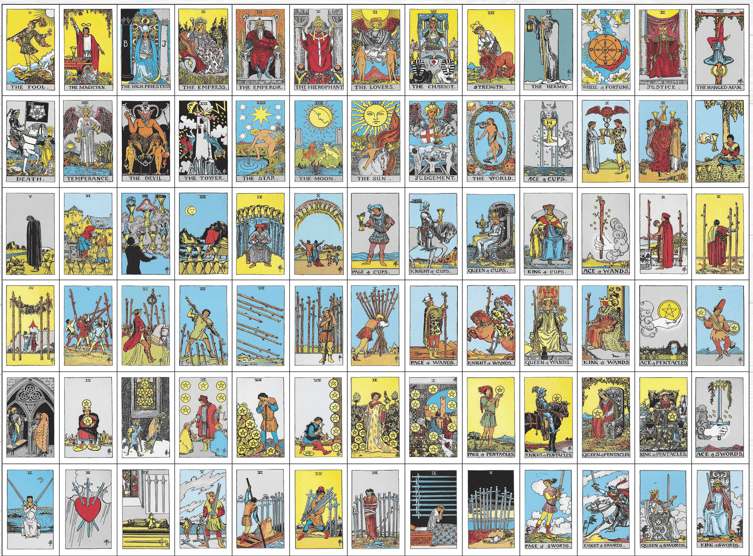
Learn how all 78 RWS tarot card meanings (upright & reversed) apply to life areas, common spread positions and key paired combinations. Waite’s original divinatory meanings are also quoted so that you can see how the imagery has been reinterpreted over time.
-
The RWS tarot is a historically significant deck published in 1909. It was created by Arthur Edward Waite and a female artist, Pamela Coleman Smith. Rider is the publisher.
The deck is has been received with enduring popularity, leading to a plethora of RWS inspired decks. In fact, it is often said to be the most popular deck in the world. This is one reason why most English-speaking tarot resources have, at least until recent years, been based on this deck.
Behind the intutiive imagery is a complex esoteric structure based on a perennialist mix of esoterica; Kabbalah, astrology, alchemy etc.
A key source for this structure is Book T, a once private document circulated among members of the Hermetic Order of the Golden Dawn, a Victorian era Rosicrucian Order. Both Waite and Smith were initiated into this group.
The result of all this is a tarot system that is easy to learn and difficult to master. One can look at the 5 of Pentacles an instantly identify it’s outer meanings of poverty and loss. Yet those meanings are derived from esoteric correspondences like Gevurah (Strength/Might) and Mercury in Taurus. If you do not study the esoteric keys, you can get confused about certain things, such as why the 10 of Pentacles and 10 of Cups are generally positive, but the 10 of Wands and 10 of Swords are distinctly negative.
-
The RWS cards in context series is a perenniailst reinterpretation of Waite’s famous 1909 deck with emphasis on the popular-modern, divinatory meanings.
The original RWS deck had divinatory meanings given in reticence whilst Waite intended it to a higher, esoteric purpose. And today, most popular tarot resources based on the Rider Waite Smith deck are focused in self-help and psychology.
This series provides a third option: modern RWS meanings suitable for divinatory readers, yet maintaining some form of Western Esoteric interpretation based on the Emanationist and perennialist practice of the series author.
-
Reference or deep study? This series can be used both as a quick reference as well as deeper study whilst you practice.
For example, you could look up Waite’s original meanings of the Empress or you could study the same Empress article to compare Waite’s meanings to the modern divinatory set that has been laid out. You could also study how the Empress can be similar to different cards in the deck dependent on the context, which helps with reading combinations on top of the explicit combination pairs already provided.
Alone or with other resources? The series is not meant to be used by itself. Rather, it was designed to be studied in conjunction with the tarot divination lessons and resources that are also available on this site.
With this in mind, below are some study tips for getting the most out of this series:
Don’t try to tackle all 78 cards at once. Start with just the 22 Major Arcana cards. When you get to the Minor Arcana, look at only the Numbered/Pip cards (the Ace-10s of those 4 Suits) before you worry about the Court Cards.
Don’t just study the cards; regularly practice reading for yourself. This is possible to do accurately, but it takes patience and careful practice.
Do keep a tarot journal in the beginning. This is to help you organize your thoughts, connect cards together and verify your predictions or intuitive insights.
Do use 3-5 card spreads at first. Whilst you can use other techniques such as lines and tableaus, spreads provide a structure for you to lean on that can help you to learn these other techniques much faster. Whereas if you start with lines or tableaus, spreads may be tricky for you.
Don’t pull more than a couple of clarifiers. This is a common beginner mistake when someone is struggling to interpret the actual spread.
Do shuffle in an occult scientific manner. Without explaining the reasoning here, I suggest that you shuffle and select your cards using a mix of riffle and overhand shuffles, then select cards by intuition. If your deck is new, do 9 or more riffles then a minute or two of overhand.
Don’t forget to prepare for every reading through a) thorough relaxation of mind and body b) heartfelt prayer or ritual. This is important for psychic protection, intuitive insights and mitigating bias from your lower self.
Note: meanings for all 78 cards were finished in December 2025.
-
Original RWS Meanings
Pictoral Key To The Tarot (1911) by A.E Waite (from sacred-texts.com)
Spiritual Key To The Tarot (2025) by Marcus Katz & Tali Goodwin
Modern Divinatory Meanings
Popular tarot card meanings resources from the internet: The Tarot Guide, Labyrinthos, Truly Teach Me Tarot.
DuQuette’s Tarot of Ceremonial Magick (book and deck). I do not use the deck anymore. But it was once in regular use to the point of being bought twice within two years.
Josephine McCarthy’s Tarot Skills for the 21st century (2020). This book was influential to my personal practice. Whilst I am not a Quareia initiate, I am a particular fan of various spreads which she released in that book (and of her approach to esotericism in general).
Further Sources: Full Bibliography
Tarot: Magic, Alchemy, Hermeticism & Neo-Platonism (3rd ed., by Robert M. Place.
LLewellyn’s Complete Guide To the Rider Waite Smith Tarot by Sasha Graham.
Holistic Tarot by Benebell Wen.
Looking Up RWS Card Meanings For A Reading?
Memorizing 1,500+ keywords is tough and boring without a proper plan. Here is my engaging meanings memory method that can have you reading all 78 cards well within 12-30 months of self-study. Enjoy.